
Video content generates 1200% more shares than text and images combined. That’s not a typo—twelve hundred percent (Brightcove).
In fact, 84% of consumers say they’ve been convinced to buy a product after watching a brand’s video. While static product images show features, product videography sells experiences and emotions.
If you’re a business owner in Australia, then you nee to include product videography in your marketing. You have three seconds—maybe less—to capture attention in a crowded social media feed, and static images aren’t enough anymore. Your products need to move, demonstrate, and create desire through dynamic storytelling.
Your competitors are already using video. The question isn’t whether you need product videography—it’s whether you can afford to fall behind.
Product videography is the art and science of capturing products in motion to sell, engage, and build brand desire.
Unlike basic product videos shot on smartphones, professional product videography combines cinematic techniques, commercial-grade equipment, and deep understanding of consumer psychology to create content that converts browsers into buyers.
But anyone can film a product spinning on a turntable. That’s documentation.
Professional product videography tells a story. It shows your product solving problems, fitting into lifestyles, and creating emotional connections. A luxury watch isn’t just rotating—it’s catching light like a piece of art, positioned on a wrist that suggests success and refinement.
Our brains are wired to notice movement. It’s evolutionary—motion meant threats or opportunities that demanded immediate attention. In digital feeds saturated with static content, product video triggers that same neurological response.
Text can describe. Images can suggest. Video proves.
And showing your product in action answers questions customers didn’t even know they had. How does it open? How does it feel in use? What happens when you press that button?
Demonstration videos eliminate uncertainty and reduce purchase anxiety. When customers see exactly how your product works, returns drop and satisfaction increases.
When GUESS shows retail environments through dynamic video storytelling, they’re not documenting stores—they’re creating emotional associations with lifestyle, aspiration, and brand identity.
Premium brands need premium presentation. Luxury showcase videography positions high-value products through cinematic quality that communicates exclusivity and craftsmanship.
When we captured Ferrari’s “Italian excellence in motion,” the brief wasn’t just to film cars—it was to create desire through visual storytelling. Every frame reinforces heritage, performance, and the emotional experience of owning automotive art.
Take a look at our campaign for Controversial Watches. Luxury videography places products in contexts that suggest the lifestyle customers want to embody. A premium watch isn’t filmed alone on white background—it’s captured in moments of achievement, sophistication, and success, with the wearer stepping out of their luxury car, watch glistening on their wrist.
Not every product needs cinematic drama. Sometimes customers just need to see how it works.
Demonstration videos are great for:
Show your product honestly performing its function. Address common questions visually, and demonstrate value through real-world use.
This transparency builds credibility. When customers see exactly what they’re getting, purchase confidence increases and returns decrease.
Products exist in contexts, and lifestyle videography shows them there.
A skincare product isn’t just sitting on a counter—it’s integrated into a morning routine. Activewear isn’t on a hanger—it’s moving through a workout that makes viewers imagine their own fitness journey.When we partnered with Rabbit Hole Playcentre—the largest playcentre in the Southern Hemisphere—the brief wasn’t to document facilities. It was to capture the magic.
Every slide, every laugh, every imaginative play area became part of a narrative that showcased what families actually experience. We didn’t just film spaces—we captured the lively spirit and boundless creativity that makes parents choose Rabbit Hole over competitors.
Social media demands platform-specific video formats, and each platform has different requirements. Here they are:
Social media videography needs to capture attention in the first second. Dynamic movement, bold visuals, and immediate value proposition separate content that performs from content that gets ignored.
Professional videography isn’t always necessary.
DIY product videos work for:
If you’re going the DIY route, at minimum you need:
But professional-looking video is exponentially harder than it appears.
You watch a 30-second product video and think “I could film that on my iPhone.” Then you try, and it looks… amateur. Flat. Lifeless. Nothing like what you imagined.
The difference isn’t just the camera. It’s understanding:
Professional videographers have spent years mastering these variables. Every “simple” product video involves dozens of technical decisions you don’t even know exist.
The numbers don’t lie. Adding product videos can boost conversion rates by up to 80% (Wyzowl, 2024), with conservative improvements of 6-30% representing massive revenue impact across your catalogue.
Plus, video on landing pages consistently achieves engagement rates above 40% (Wistia, 2023)—nearly half your visitors actually watch, compared to the tiny fraction who read descriptions.
And customers who watch product videos are 85% more likely to purchase (Forbes, 2023).
If your product generates $30,000 monthly and videography increases conversions by just 15%, that’s $54,000 annually. From one video.
Even a $5,000 investment delivers 1,080% first-year return. Quality product videography performs for 2-3 years across multiple campaigns.
For high-value products or competitive markets, professional videography isn’t an expense—it’s the investment that makes everything else profitable.
The right videography partner combines technical expertise with commercial understanding.
Look beyond surface-level aesthetics. Examine:
Australian market experience matters. Videographers who understand local consumer preferences and competitive landscapes create content that resonates with your actual customers.
Pre-production and concept development
Production and project management
Post-production and revisions
Rights and ongoing relationships
Technical proficiency is baseline. What separates exceptional videographers is storytelling ability.
Do they understand your brand values and target audience? Can they translate brand guidelines into compelling visual narrative? Do they innovate within your category or replicate generic approaches?
Client testimonials reveal more than reels. Look for specific results and commercial impact, not just creative praise.
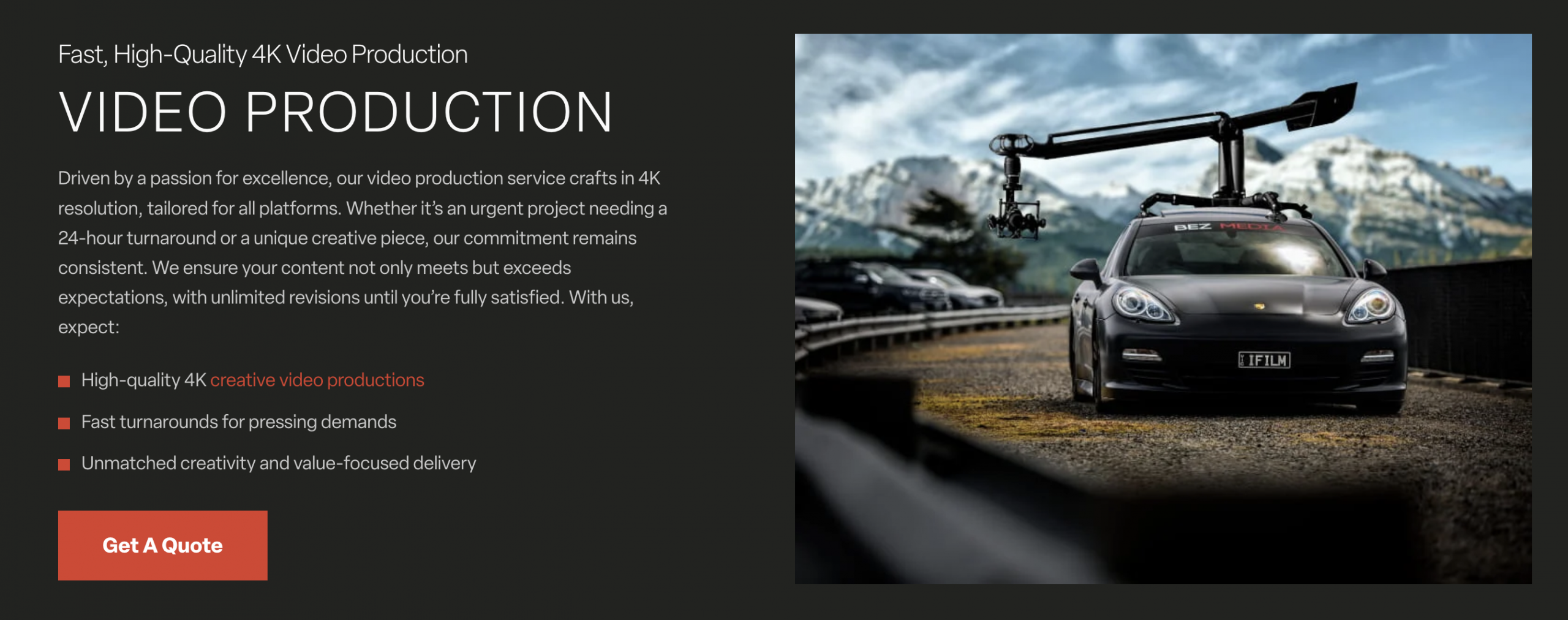
Bez Agency delivers world-class product videography for brands that demand visual excellence. We’ve created product videography for Ferrari’s automotive excellence, GUESS lifestyle storytelling, Lamborghini luxury positioning, National Geographic Australia, and LEGO’s playful brand narrative.
We understand Australian and global markets, consumer preferences, and competitive landscapes.
We don’t just create beautiful videos—we build visual assets that drive measurable business results. Every project combines creative vision with commercial pragmatism focused on ROI.
Ready to transform your product marketing with videography that actually converts?
Book your consultation today and let’s create video content that makes your competition irrelevant.
Product photography captures static moments that showcase product features and aesthetics. Product videography adds motion, demonstrating functionality and creating emotional connections through dynamic storytelling. Both are essential—photography for catalogues and quick reference, videography for engagement and conversion optimisation.
Professional product videography typically costs $2,000-$15,000+ depending on project scope, complexity, and deliverables. Simple product demonstrations start around $2,000-$4,000, while complex productions with multiple products, locations, or advanced post-production can exceed $15,000. Calculate ROI based on potential conversion improvements rather than just upfront costs.
Instagram and TikTok perform best with vertical video (9:16) for Stories and Reels. Feed content should use square formats (1:1) to maximise screen space. YouTube and website embedding require horizontal video (16:9). Professional videographers deliver multiple format versions optimised for each platform’s specifications.
Absolutely. Start with focused videos for hero products or best-sellers rather than filming entire catalogues. Simple demonstration videos or founder story content can be produced affordably while delivering significant ROI. As revenue grows, expand video production to support scaling. Even modest video investment typically outperforms equivalent spending on static imagery.
Yes. Each platform has different technical requirements, audience expectations, and optimal video lengths. Professional videography services deliver multiple versions from single shoots—vertical for Stories, square for feeds, horizontal for websites. Platform-specific optimisation significantly improves performance versus one-size-fits-all approaches.